In Texas a Family of 9, What Income Is Poverty
Executive Summary
Today, the Demography Bureau released its annual poverty written report, which alleged that a tape 46.2 meg persons, or roughly one in seven Americans, were poor in 2010. The numbers were up sharply from the previous year's total of 43.six 1000000. Although the current recession has increased the numbers of the poor, loftier levels of poverty predate the recession. In most years for the past 2 decades, the Census Bureau has declared that at least 35 1000000 Americans lived in poverty.
Withal, understanding poverty in America requires looking behind these numbers at the actual living conditions of the individuals the regime deems to be poor. For most Americans, the word "poverty" suggests near destitution: an disability to provide nutritious food, wear, and reasonable shelter for 1'south family. All the same, only a pocket-size number of the 46 million persons classified every bit "poor" past the Demography Bureau fit that description. While real material hardship certainly does occur, it is limited in scope and severity.
The following are facts near persons divers every bit "poor" by the Census Agency every bit taken from various government reports:
- 80 percent of poor households have air workout. In 1970, but 36 percent of the entire U.Due south. population enjoyed air conditioning.
- 92 percent of poor households have a microwave.
- Nearly iii-fourths have a auto or truck, and 31 percent have two or more cars or trucks.
- Nearly two-thirds take cable or satellite Television receiver.
- 2-thirds have at least one DVD thespian, and lxx pct have a VCR.
- One-half have a personal computer, and one in seven have two or more computers.
- More than half of poor families with children take a video game system, such as an Xbox or PlayStation.
- 43 percent have Cyberspace access.
- 1-3rd take a wide-screen plasma or LCD Television set.
- One-quaternary have a digital video recorder organisation, such as a TiVo.
For decades, the living weather of the poor take steadily improved. Consumer items that were luxuries or significant purchases for the center class a few decades agone accept become commonplace in poor households, partially because of the normal downward price trend that follows introduction of a new product.
Liberals use the declining relative prices of many amenities to argue that information technology is no big bargain that poor households accept air workout, computers, cable TV, and wide-screen TV. They debate, polemically, that even though virtually poor families may have a house full of modernistic conveniences, the average poor family still suffers from substantial impecuniousness in bones needs, such as food and housing. In reality, this is just not truthful.
Although the mainstream media circulate alarming stories about widespread and astringent hunger in the nation, in reality, most of the poor do not feel hunger or food shortages. The U.S. Department of Agriculture collects data on these topics in its household food security survey. For 2009, the survey showed:
- 96 per centum of poor parents stated that their children were never hungry at any fourth dimension during the year because they could non afford food.
- 83 percent of poor families reported having enough food to consume.
- 82 percent of poor adults reported never existence hungry at whatever time in the prior yr due to lack of money for nutrient.
Other authorities surveys show that the average consumption of protein, vitamins, and minerals is virtually the same for poor and middle-class children and is well to a higher place recommended norms in well-nigh cases.
Goggle box newscasts about poverty in America mostly portray the poor as homeless people or equally a destitute family living in an overcrowded, dilapidated trailer. In fact, however:
- Over the grade of a year, 4 percent of poor persons become temporarily homeless.
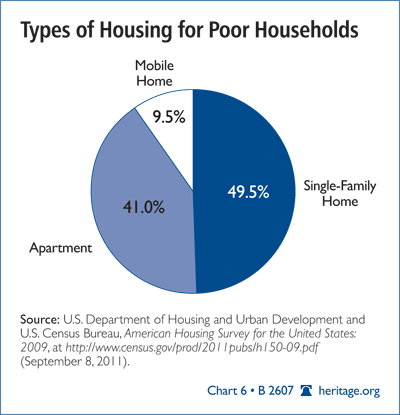
- Only nine.five percent of the poor live in mobile homes or trailers, 49.v percentage live in divide single-family houses or townhouses, and 40 percent live in apartments.
- 42 percent of poor households really own their own homes.
- Only 6 percent of poor households are overcrowded. More than than 2-thirds have more than than two rooms per person.
- The average poor American has more living infinite than the typical non-poor person in Sweden, French republic, or the Britain.
- The vast bulk of the homes or apartments of the poor are in good repair.
By their own reports, the average poor person had sufficient funds to meet all essential needs and to obtain medical care for family members throughout the year whenever needed.
Of course, poor Americans do not live in the lap of luxury. The poor conspicuously struggle to make ends run across, merely they are by and large struggling to pay for cable TV, air-conditioning, and a machine, also every bit for food on the table. The average poor person is far from affluent, simply his lifestyle is far from the images of stark impecuniousness purveyed equally by advocacy groups and the media.
The fact that the boilerplate poor household has many modernistic conveniences and experiences no substantial hardships does not mean that no families face up hardships. Equally noted, the overwhelming majority of the poor are well housed and not overcrowded, but one in 25 will go temporarily homeless during the year. While most of the poor take a sufficient and fairly steady supply of food, one in five poor adults will experience temporary food shortages and hunger at some indicate in a year.
The poor man who has lost his dwelling or suffers intermittent hunger will find no consolation in the fact that his condition occurs infrequently in American society. His hardships are real and must exist an important concern for policymakers. Yet, anti-poverty policy needs to exist based on accurate information. Gross exaggeration of the extent and severity of hardships in America will non do good society, the taxpayers, or the poor.
Finally, welfare policy needs to address the causes of poverty, non but the symptoms. Amidst families with children, the collapse of union and erosion of the piece of work ethic are the principal long-term causes of poverty. When the recession ends, welfare policy must require able-bodied recipients to work or set up for piece of work as a condition of receiving aid. It should as well strengthen marriage in low-income communities rather than ignore and penalize it.
— Robert Rector is Senior Inquiry Fellow in the Domestic Policy Studies Department, and Rachel Sheffield is a Research Banana in the Richard and Helen DeVos Center for Religion and Civil Society, at The Heritage Foundation.
Understanding Poverty in the Us: Surprising Facts About America'south Poor
Abstract: The Demography Bureau'southward annual poverty report presents a misleading picture of poverty in the Us. Few of the 46.two million people identified by the Census Bureau as beingness "in poverty" are what nearly Americans would consider poor—lacking nutritious food, acceptable warm housing, or clothing. The typical "poor" American lives in an air-conditioned house or apartment and has cable TV, a car, multiple colour TVs, a DVD player, and a VCR amid other conveniences. While some of the poor face significant material hardship, formulating a sound, long-term anti-poverty policy that addresses the causes too as the symptoms of poverty volition require honest and accurate information. Exaggerating the extent and severity of hardships will non benefit society, the taxpayers, or the poor.
Today, the Census Bureau released its annual poverty written report, which alleged that 46.2 million, or roughly i in 7 Americans were poor in 2010.[1] The numbers were upwardly sharply from the previous year's total of 43.half dozen million. Although the current recession has increased the numbers of the poor, high levels of poverty predate the recession. In near years for the past ii decades, the Census Bureau has declared that at to the lowest degree 35 1000000 Americans lived in poverty.
However what practise these numbers actually hateful? What does it mean to be poor in America? For most Americans, the word "poverty" suggests almost destitution: an inability to provide nutritious food, clothing, or reasonable shelter for one's family. For case, the Poverty Pulse poll past the Catholic Campaign for Homo Development in 2005 asked the general public: "How would you describe being poor in the U.South.?" The overwhelming majority of responses focused on homelessness, hunger or not being able to eat properly, and non beingness able to see bones needs.[2] Yet if poverty means lacking nutritious food, adequate warm housing, and clothing, relatively few of the 46 million people identified past the Demography Bureau as being "in poverty" could be characterized as poor.
The Demography Agency's poverty report is widely publicized by the press. Regrettably, the report provides only a bare count of the number of Americans defined equally poor by the government. It provides no data on or clarification of their actual living conditions. Nonetheless, several other federal surveys provide detailed information on the living conditions of the poor.[three] These surveys provide a very different sense of American poverty. They reveal that the actual standard of living of America's poor—in terms of amenities in the home, housing, food consumption, and nutrition—is far higher than expected.
These surveys testify that nigh people whom the government defines as "in poverty" are not actually poor in whatever ordinary sense of the term. While material hardship does exist in the Us, it is restricted in scope and severity. Regrettably, the mainstream press rarely reports on these detailed surveys of living weather condition.
Amenities in Poor Households
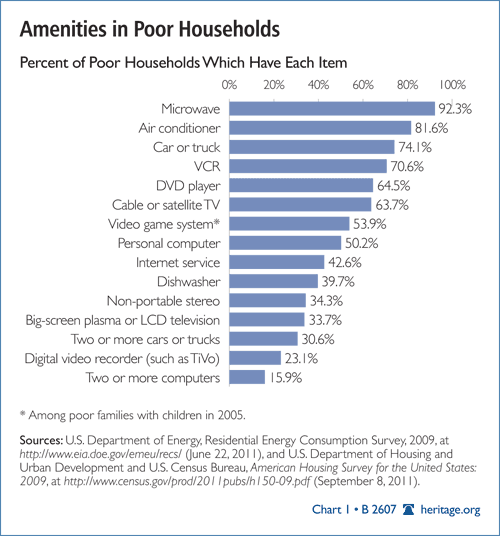
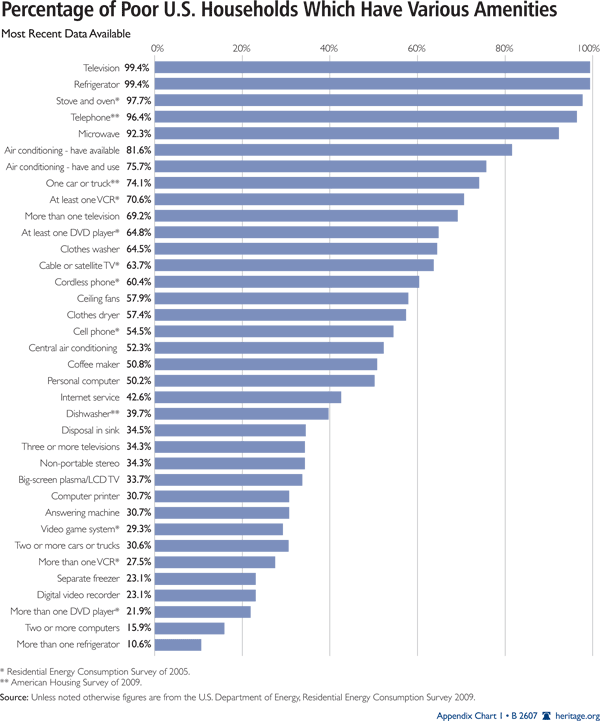
Chart 1 shows ownership of property and consumer durables amidst poor households based on data from the 2009 American Housing Survey,[4] which was conducted past the U.South. Department of Housing and Urban Development and the Census Bureau, and the 2009 Residential Energy Consumption Survey, which was conducted by the U.Due south. Department of Energy.[five] These surveys show that:
- lxxx percent of poor households take air workout. By dissimilarity, in 1970, only 36 percent of the U.Southward. population enjoyed air-conditioning.
- 92 percentage of poor households accept a microwave.
- About three-fourths have a car or truck, and 31 percent have two or more cars or trucks.
- Most 2-thirds have cable or satellite TV.
- Ii-thirds have at least one DVD player, and seventy per centum have a VCR.
- Half have a personal computer, and one in 7 have two or more than computers.
- More than one-half of poor families with children take a video game system, such every bit an Xbox or PlayStation.
- 43 percent have Internet service.
- 40 per centum take an automated dishwasher.
- One-3rd take a broad-screen plasma or LCD TV.
- Around one-fourth have a digital video recorder, such as a TiVo.
- More than half have a cell phone.
Of course, nearly all poor households have commonplace amenities such as colour TVs, telephones, and kitchens equipped with an oven, stove, and refrigerator.
In 2005, more than than half of poor households had at to the lowest degree five of the following 10 conveniences: a computer, cable or satellite TV, air conditioning, Internet service, a large-screen Television, not-portable stereo, computer printer, separate freezer or second refrigerator, microwave, and at to the lowest degree one color TV. 1-fourth of the poor had seven or more of these 10 items in their homes. (Meet Chart two.)
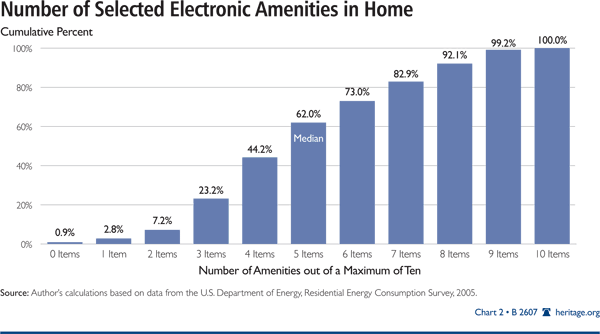
The exact combination of these 10 civilities obviously varied from one poor household to the next. Median or average poor households (five of 10 amenities) most commonly had air conditioning, cablevision Boob tube, a stereo, microwave, and at least one Goggle box.
Since 2005, the share of poor households having air conditioning, computers, wide-screen TVs, Internet service, and microwaves has increased significantly. Today, it is probable that a majority of poor households have at least half-dozen of the 10 items.
Steady Improvement in Living Atmospheric condition
Are the numbers in Chart 1 a fluke? Have they been inflated by working-class families with lots of conveniences in the home who have lost jobs in the recession and temporarily joined the ranks of the poor? No. The data indicate that the broad array of modern conveniences in the homes of the poor is the result of decades of steady progress in the living standards of the poor. Year past year, the poor tend to be better off. Consumer items that were luxuries or pregnant purchases for the middle class a few decades ago take go commonplace in poor households.
In office, this is acquired by a normal downward trend in prices subsequently a new product is introduced. Initially, new products tend to be expensive and therefore available only to the affluent. Over time, prices fall sharply, and the product saturates the unabridged population including poor households. As a rule of thumb, poor households tend to obtain modern conveniences virtually a dozen years afterward the middle class. Today, nigh poor families have conveniences that were major purchases or unaffordable to the middle class not too long ago.
Liberals use the declining relative prices of many amenities to argue that it is no big deal that poor households have air conditioning, computers, and cable TV. They contend that even though nearly poor families have houses full of modern conveniences, the average poor family still suffers from serious impecuniousness in basic needs, such as nutrient, nutrition, and housing.[6] While such an outcome is theoretically possible, this paper demonstrates that this is not the instance. In fact, the overwhelming majority of poor households have an adequate and reasonably steady supply of food, are not hungry, and are well housed.
Poverty and Malnutrition
Malnutrition (also called undernutrition) is a status of reduced health due to a chronic shortage of calories and nutriments. At that place is picayune or no evidence of poverty-induced malnutrition in the United States. It is frequently believed that a lack of fiscal resources forces poor people to eat low-quality diets that are deficient in nutriments and high in fat, but survey information show that nutriment density (corporeality of vitamins, minerals, and protein per kilocalorie of nutrient) does not vary by income course.[7] Nor exercise the poor eat higher-fatty diets than do members of the middle class. The per centum of persons with high fat intake (as a share of total calories) is almost the same for low-income and upper-middle-income persons.[viii] Still, overconsumption of calories is a major trouble among the poor, equally it is in the general U.Southward. population.
Examination of the average nutriment consumption of Americans reveals that age and gender play a far greater role than income class in determining nutritional intake. For instance, the nutriment intakes of adult women in the upper eye form (incomes above 350 percent of the poverty level—roughly $76,000 for a family of iv in today's dollars) more closely resemble the intakes of poor women than those of upper-middle-class men, children, or teens.[nine] The boilerplate nutriment consumption of upper-middle-income preschoolers is virtually identical with that of poor preschoolers, simply non with the consumption of adults or older children in the upper middle form.
This same blueprint holds for developed males, teens, and most other age and gender groups. In general, children who are 0–xi years old have the highest boilerplate level of nutriment intakes relative to the recommended daily allowance (RDA), followed by adult and teen males. Adult and teen females have the lowest level of intakes. This pattern holds for all income classes.
Diet and Poor Children. Government surveys provide lilliputian prove of widespread undernutrition amidst poor children. In fact, they show that the average nutriment consumption amidst the poor closely resembles consumption among the upper middle class. Children in families with incomes below the poverty level actually swallow more meat than do children in upper-middle-class families.
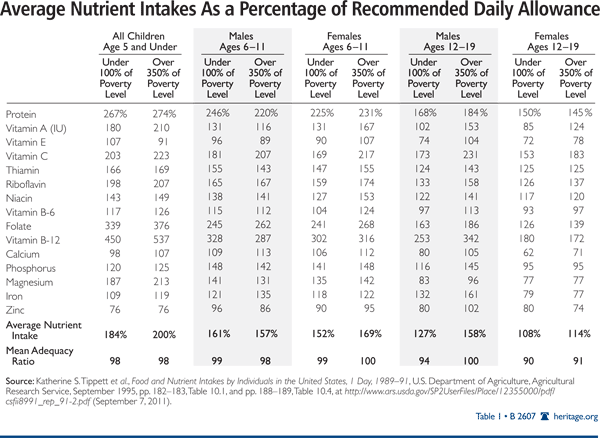
Table 1 shows the boilerplate intake of protein, vitamins, and minerals as a percentage of the RDA among poor and middle-class children at diverse age levels.[x] The intake of nutriments is very similar for poor and middle-class children and is generally well above the recommended daily level. For instance, the consumption of protein (a relatively expensive nutriment) among poor children averages between 150 percent and 267 percent of the RDA.
When shortfalls of specific vitamins and minerals appear (for example, amidst teenage girls), they tend to be very similar for the poor and the middle class. While poor teenage girls, on average, tend to underconsume vitamin Eastward, vitamin B-6, calcium, phosphorus, magnesium, iron, and zinc, a well-nigh identical underconsumption of these same nutriments appears amidst upper-eye-course girls. Along these lines, the USDA reports that at that place is no difference in diet quality between high and low-income children as measured by its salubrious eating index.[xi]
Poor Children's Weight and Stature. On boilerplate, poor children are very well nourished, and there is no evidence of widespread significant undernutrition. For case, two indicators of undernutrition amid the immature are "thinness" (depression weight for height) and stuntedness (depression acme for age). These problems are rare to nonexistent amongst poor American children.
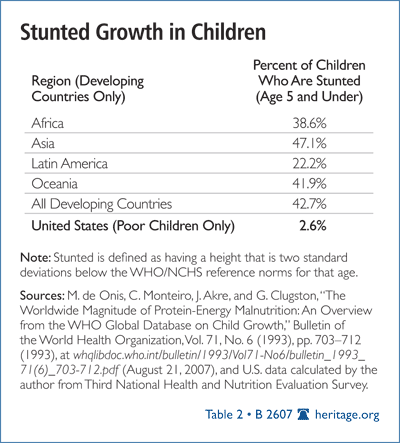
The generally good wellness of poor American children can be illustrated by international comparisons. Table two provides data on children'south size based on the World Health Organization (WHO) Global Data Base on Child Growth: Children are judged to be short or "stunted" if their tiptop falls below the two.3 percentile level of standard tiptop-to-age tables.[12] Table two shows the pct of children under v years of age in developing nations who are judged to be "stunted" past this standard.
In developing nations, some 43 percent of children are stunted. In Africa, more than one-third of immature children are affected; in Asia, nearly half.[thirteen] By dissimilarity, in the Us, some two.6 percent of immature children in poor households are stunted by a comparable standard—a charge per unit only slightly in a higher place the expected standard for healthy, well-nourished children.[14] While business organization for the well-being of poor American children is always prudent, the information underscore how large and well-nourished poor American children are past global standards.
Throughout this century, improvements in nutrition and health accept led to increases in the growth charge per unit and the ultimate height and weight of American children. Poor children have clearly benefited from this trend. Today, poor boys at ages 18 and nineteen are actually taller and heavier than boys of similar age in the full general U.S. population in the late 1950s. They are one inch taller and some 10 pounds heavier than GIs of like age during Earth War II and nigh two inches taller and 20 pounds heavier than American doughboys back in World War I.[15]
Poverty and Consistency of Food Supply
Nearly poor Americans are non undernourished, merely experience an abundance of nutrient over time rather than chronic shortfalls of nutrient. Nevertheless, even though the poor generally have an aplenty food supply, some do suffer from temporary food shortages. For example, even if a poor household has an adequate or good overall food supply when measured over a moderate period, information technology even so might need to cutting back meals or go without if food stamps run out at the finish of the month. This trouble of temporary food shortages leads some advocates to merits that there is widespread "hunger" in the United states.[16]
The electric current deep recession and prolonged loftier levels of unemployment have made it much more difficult for families to accept a steady supply of food. Many families accept been forced to eat less expensive nutrient than they are accustomed to eating. Nonetheless, USDA survey data show that almost households, poor or non-poor, do not suffer even temporarily from nutrient shortages.[17] As Chart 3 shows, during the recession in 2009, 95 percent of all U.S. households report that they had "plenty nutrient to eat," although non always the kinds of food that they would have preferred. Some 3.ix percent of all households written report they "sometimes" did not take enough food to eat, while 1 percent said they "oftentimes" did not have enough food.[18]
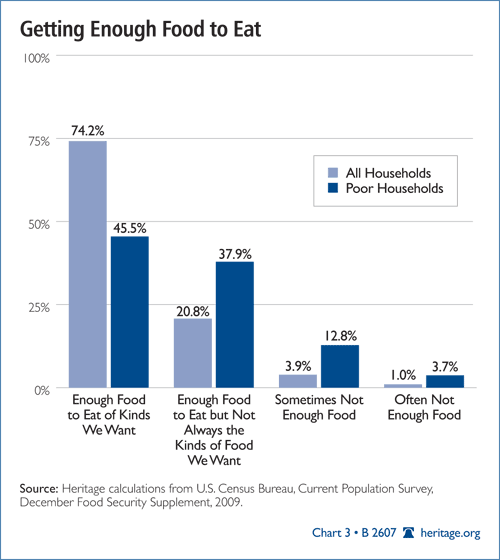
Amid the poor, the figures are slightly lower: 83.4 per centum of poor households asserted that they e'er had "enough food to swallow," although a total 38 percent of these did non ever take the foods they would accept preferred. Some 13 pct of poor households stated that they "sometimes" did not take enough food, and 3.7 percent said that they "often" did not have plenty nutrient.[nineteen] The bottom line is that, although a meaning portion of poor households practice study temporary food shortages, 5 out of vi poor households stated that they had enough food to swallow fifty-fifty in the middle of a recession.
Poverty and Temporary Food Shortages. The USDA too measures temporary nutrient shortages inside households, a condition it calls "very depression food security."[twenty] According to the USDA, in households with very depression food security, the "eating patterns of one or more than household members were disrupted and their nutrient intake reduced, at least some fourth dimension during the year, because they couldn't beget plenty nutrient."[21]
At times, these households worried that nutrient would run out, ate unbalanced meals, and relied on cheaper foods. In addition, adults ordinarily cut dorsum on the size of their meals or skipped meals to save coin. In a majority of these households, adults reported feeling hungry at times but non eating due to a lack of food.[22] In the overwhelming bulk of households with very low food security, adults ate less while shielding children from reductions in food intake.
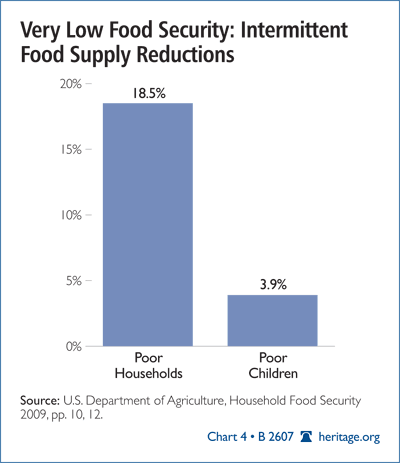
Very low food security is almost always an intermittent and episodic problem for families rather than a chronic condition. The boilerplate family with very low food security experienced disrupted nutrient intakes in 7 months of the year, for one to 7 days per calendar month.[23]
As Nautical chart 4 shows, roughly one in five poor households (18.5 percent) experienced very low food security or temporary disruptions and reductions in normal food intake in at least i month during 2009.[24] At some point during the aforementioned period, 3.9 percent of poor children also experienced very low food security.[25] Put in other terms, even during a astringent recession, four out of v poor households and 96 per centum of poor children did not experience any meaning reductions or disruptions of food intake during the year.
Poverty and Hunger. The USDA likewise asks specific questions near existence "hungry." (See Chart 5.) For instance, in 2009, the USDA asked poor adults: "In the last 12 months, were y'all always hungry, but didn't eat, because there wasn't enough coin for food?" Even in the heart of a severe recession, 82 percent of poor adults reported they were never hungry at whatsoever time in the prior year due to lack of money to purchase food.[26]
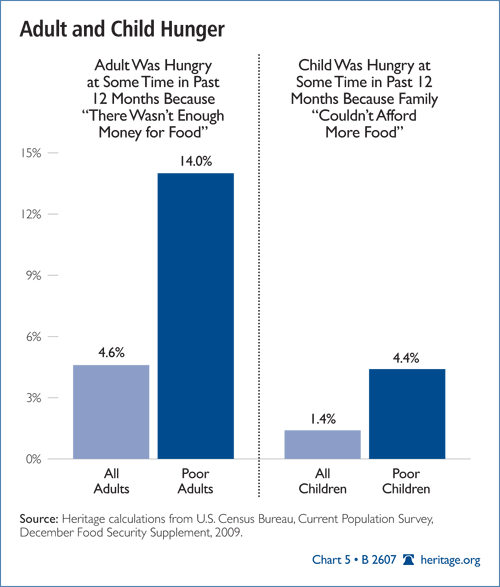
In 2009, the USDA likewise asked parents living in poverty the following question nearly their children: "In the last 12 months, were the children ever hungry but you just couldn't beget more nutrient?" Some 96 percent of poor parents responded that their children had never been hungry during the previous year due to a lack of nutrient resources. Only 4 percent of poor parents responded that their children had been hungry at some point in the year.[27]
Poverty and Homelessness
The mainstream press and activist groups frequently conflate poverty with homelessness. News stories about poverty often feature homeless families living "on the street."[28] This depiction is seriously misleading because merely a small-scale portion of persons "living in poverty" will become homeless over the course of a twelvemonth. The overwhelming bulk of the poor reside throughout the year in non-crowded housing that is in good repair.
The 2009 Annual Homeless Cess Written report to Congress published by the U.S. Section of Housing and Urban Evolution (HUD) states that on a given dark in 2009, some 643,000 persons in the U.Due south. were homeless (without permanent domicile).[29] This means that at any given time, 1 out of 470 persons in the general population or one out of 70 persons with incomes below the poverty level was homeless.[thirty]
Moreover, two-thirds of the 643,000 homeless persons were residing in emergency shelters or transitional housing. Only 240,000 were without shelter; these "unsheltered" individuals were "on the street," meaning that they were living in cars, abased buildings, alleyways, parks, or similar places.[31] At any point in 2009, roughly i person out of 1,250 in the general population or ane out of 180 poor persons was homeless in the literal sense of beingness on the street and without shelter.
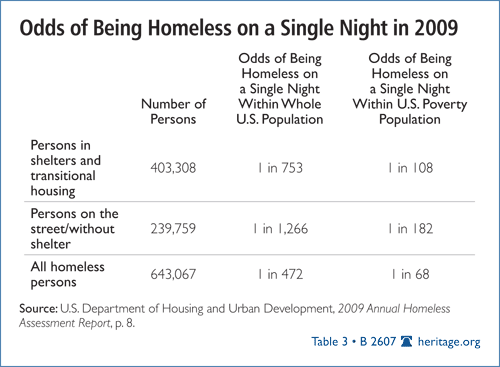
Homelessness is normally a transitional condition. Individuals typically lose housing, reside in an emergency shelter for a few weeks or months, and then reenter permanent housing. The transitional nature of homelessness ways that many more people go temporarily homeless over the course of a year than are homeless at any single point in time. Thus, HUD reports that 1.56 million persons resided in an emergency shelter or transitional housing at to the lowest degree one nighttime during 2009.[32] The yr-round total of individuals who always stayed in a shelter or transitional housing was nearly iv times larger than the 403,000 who resided in such facilities on an average dark.[33]
Based on the year-round data on shelter use, roughly 1 person in 195 in the general population resided in an emergency shelter or transitional housing for at least one night during a total 12-month period. Roughly one in 25 poor persons (four pct of all poor persons) resided in an emergency shelter or transitional housing for at least ane nighttime during the total year.[34]
Although news stories oft suggest that poverty and homelessness are similar, this is inaccurate. In reality, the gap betwixt the living weather of a homeless person and the typical poor household are proportionately equally peachy equally the gap between the poor household and a eye-course family in the suburbs.
Housing Conditions and Poverty
When the mainstream media do non portray the poor as homeless, they will oftentimes present them as living in dismal conditions such as an overcrowded, battered trailer. Once more, regime survey data provide a very different picture. Most poor Americans live in conventional houses or apartments that are in good repair. As Chart vi shows, 49.v percent of poor households live in unmarried-family unit homes, either unattached unmarried dwellings or fastened units such every bit townhouses. Some other 41 percent alive in apartments, and 9.5 percent live in mobile homes.[35]
Poverty and Crowding. Both the overall U.Due south. population and the poor in America alive in very spacious housing. As Table 4 shows, 71 percent of all U.South. households have two or more rooms per tenant. Among the poor, this figure is 65 pct.
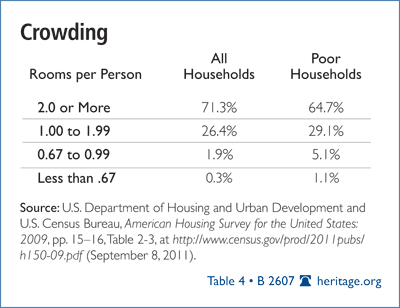
Crowding is quite rare. Simply two.two pct of all households and 6.2 percent of poor households are crowded with less than one room per person.[36] By contrast, social reformer Jacob Riis, writing on tenement living atmospheric condition around 1890 in New York City, described crowded families living with four or five persons per room and some 20 foursquare feet of living space per person.[37]
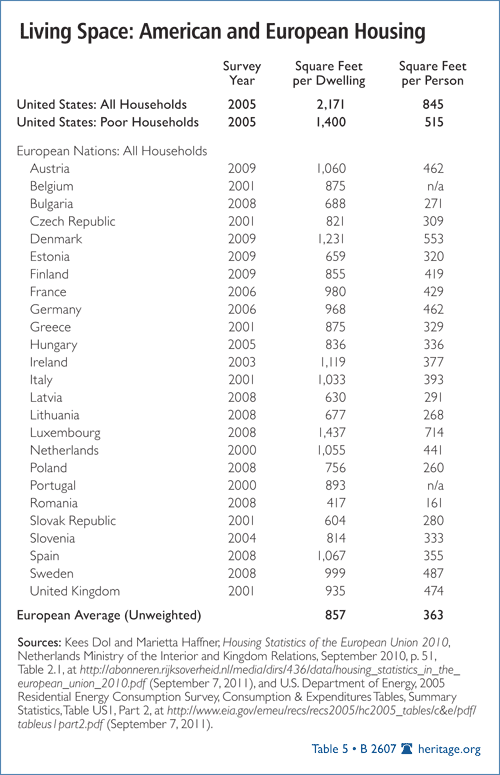
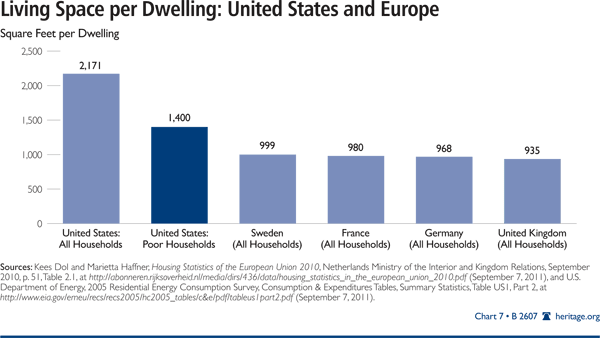
Living Space: Europe Versus the Usa. Another way of measuring living space is the square footage of a dwelling. Every bit Nautical chart half dozen and Table 5 prove, U.South. houses and apartments are, on boilerplate, much larger than their European counterparts. With ii,171 square feet of living infinite, the average U.S. domicile is more than than twice the size of the average home in Europe, including those in highly developed economies, such as Sweden (999 foursquare feet); France (980 square feet); Frg (968 foursquare feet); and the U.k. (935 square feet).[38] Dividing the total living infinite of a dwelling by the number of persons living at that place yields living space per person. By this mensurate, the average U.Southward. household has more than twice the living space of the average European household.
Living Space: Europeans Versus Poor Americans. As Nautical chart 7 and Table 5 prove, on average, the dwellings of poor Americans are nigh 2-thirds the size of the boilerplate U.S. dwelling. Notwithstanding, at 1,400 square anxiety, the dwelling of the boilerplate poor American is however substantially larger than the average abode in every European nation except Grand duchy of luxembourg. For example, the average dwelling house of poor Americans is 40 per centum larger than the average dwelling unit in Sweden (999 foursquare feet). (This comparing is between poor Americans and the average citizen in the whole population within each European nation, not poor Europeans.)
Poor American households tend to have somewhat more people on boilerplate than do European households; all the same, as Table 5 shows, at 515 foursquare feet per person, the average poor American has more than living infinite than the average denizen—not just the poor—in every European nation except Grand duchy of luxembourg and Denmark.
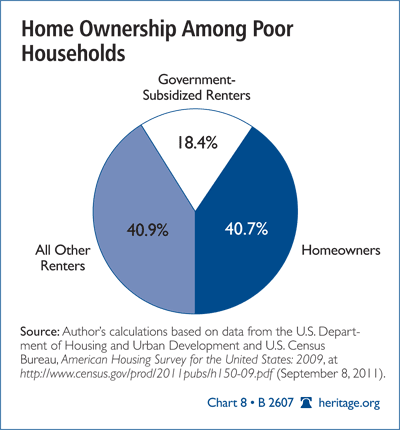
Poverty and Home Ownership. The American Housing Survey reports that roughly 41 percent of poor households owned their ain homes. The average domicile owned by persons classified equally poor by the Demography Bureau is a three-bedchamber house with one-and-a-half baths, a garage, and a porch or patio. The median value of homes owned by poor households was $100,000 in 2009, or sixty percent of the median value of all homes owned in the United states.[39]
The remaining poor households lived in rental housing. As Chart 8 shows, roughly one-fifth of all poor households lived in government-subsidized rental housing. Around 41 percent lived in rented apartments or houses without government aid.[40]
Housing Quality. Of form, the housing of poor American households could exist spacious but still dilapidated or unsafe. Nevertheless, the American Housing Survey indicates otherwise. For example, the survey reports that only a minor portion of poor households (3.1 percent) and an even smaller portion of total households (1.7 percent) have "severe physical problems." The nigh common severe problem is a shared bathroom, which occurs when occupants lack a private bathroom and must share bathroom facilities with individuals in a neighboring unit. This condition affects nearly 1 pct of all U.S. households and 1.4 percent of all poor households. About i percent of all households and two percent of poor households take other "astringent concrete problems." The most common is repeated heating breakdowns.[41]
The American Housing Survey also indicates that half dozen.8 percent of the poor and iii.5 percent of total households have "moderate physical problems." The most common moderate concrete problems are budget problems, lack of a full kitchen, and use of unvented oil, kerosene, or gas heaters as the primary oestrus source.[42]
Essential Needs. Although the public equates poverty with physical deprivation, the overwhelming bulk of poor households do not feel any grade of physical impecuniousness. Some 70 percent of poor households study that during the form of the past year, they were able to run across "all essential expenses," including mortgage, rent, utility bills, and of import medical care. Although it is widely supposed that the poor cannot obtain medical care, simply 13 percentage of poor households written report that a family member needed to go to a doctor or infirmary at some point in the prior year but was unable to do so because the family could not afford the cost.[43]
Public Understanding of Poverty
In 2005, the typical poor household, equally defined by the federal government, had air conditioning and a machine. For entertainment, the household had two color TVs, cable or satellite Boob tube, a DVD thespian, and a VCR. In the kitchen, information technology had a refrigerator, an oven and stove, and a microwave. Other household conveniences included a dress washer, clothes dryer, ceiling fans, a cordless telephone, and a coffee maker. The family was able to obtain medical care when needed. Their home was not overcrowded and was in good repair. By its own written report, the family unit was not hungry and had sufficient funds during the by year to meet all essential needs.[44]
The overwhelming majority of Americans do not regard a family living in these weather condition as poor. For example, a poll conducted in June 2009 asked a nationally representative sample of the public whether they agreed or disagreed with the following statement: "A family in the U.Southward. that has a decent, un-crowded business firm or apartment to live in, aplenty food to swallow, access to medical care, a motorcar, cable Television set, air workout and a microwave at home should not be considered poor."[45] A full 80 per centum of Republicans and 77 percent of Democrats agreed that a family living in those living atmospheric condition should not exist considered poor.
Census Poverty Reports: Misleading and Inaccurate
Nonetheless, each year, the Census Bureau bug a study claiming that more than 35 million Americans alive in poverty. The annual report is flawed in two respects.
Starting time, it provides no information on the actual living atmospheric condition of the persons identified as poor. It only states that a specified number of persons are poor without giving any information on what poverty means in the existent globe. A detailed description of the living conditions of the poor would greatly enhance public understanding. In fact, without a detailed description of living atmospheric condition, public discussions of poverty are meaningless.
Second, the study massively undercounts the economic resource provided to poor people. The Census Bureau asserts that a household is poor if its "money income" falls below a specified threshold. In 2010, the poverty income threshold for a family unit of four was $22,314. However, in counting the money income of households, the Demography Bureau excludes nigh all welfare assistance. For example, more than seventy means-tested welfare programs provide cash, food, housing, medical intendance, and social services to poor and low-income persons,[46] including Temporary Assist for Needy Families (TANF), Supplemental Security Income (SSI), the Earned Income Tax Credit (EITC), food stamps, the Women, Infants, and Children (WIC) food program, public housing, and Medicaid. (Social Security and Medicare are non means-tested programs.)
In 2008, federal and state governments spent $714 billion on means-tested welfare programs, simply the Demography Bureau counted only almost 4 percentage of this as coin income in determining whether a household was poor. The lesser line is that the economic resources bachelor to poor persons are vastly greater than the report claims.
In fact, the U.S. Section of Labor finds that the one-fifth of households with the lowest incomes appear to spend $1.87 for every $1.00 of income that the Census Agency says they receive. If the gratuitous medical care and public housing subsidies given to these households were counted, the gap between expenditure and income would be fifty-fifty greater.[47]
Was the State of war on Poverty a Success?
In 2010, regime spent $871 billion on means-tested assistance. This amounts to nearly $ix,000 for every poor and depression-income American. Many "poor" families have higher-than-expected living standards considering they receive considerable authorities aid that is "off the books" for purposes of measuring poverty. Do the higher living standards of the poor mean that the welfare state has been successful?
The answer is: yes and no. Not even the government can spend $nine,000 per person without significantly affecting living conditions. Nonetheless, the original goal of the War on Poverty was not to prop up living standards artificially through an ever-expanding welfare state. When Lyndon Johnson launched the War on Poverty, he intended it to strike "at the causes, not only the consequences of poverty."[48] He added, "Our aim is not but to salve the symptom of poverty, only to cure it and, above all, to prevent it."[49]
President Johnson was not proposing a massive system of ever-increasing welfare benefits doled out to an ever-growing population of beneficiaries. His proclaimed goal was not to create a massive new system of government handouts, but to increase self-sufficiency in a new generation, enabling them to elevator themselves out of poverty without government handouts. LBJ planned to reduce, not increase, welfare dependence. The goal of the War on Poverty was "making taxpayers out of taxeaters."[50] He declared, "Nosotros desire to requite the forgotten fifth of our people opportunity not doles."[51]
The U.Due south has spent over $17 trillion on ways-tested welfare since LBJ launched the War on Poverty. Over time, the material living atmospheric condition of the poor have improved. It would exist impossible to spend $17 trillion without whatever positive impact on living weather condition, merely in terms of reducing the "causes" rather than the "consequences" of poverty, the State of war on Poverty has failed utterly. The state of affairs has gotten worse, not meliorate. A significant portion of the population is at present less capable of prosperous self-sufficiency than they were when the War on Poverty began.
Addressing the Causes, Not Merely the Symptoms, of Poverty
A major element in the declining chapters for self-back up is the collapse of union in depression-income communities. As the War on Poverty expanded benefits, welfare began to serve every bit a substitute for a husband in the home, and low-income marriage began to disappear. When Johnson launched the State of war on Poverty, seven percent of American children were built-in out of matrimony. Today, the number is over 40 per centum. As married fathers disappeared from the home, the need for more welfare to back up single mothers increased. The War on Poverty created a destructive feedback loop: Welfare undermined spousal relationship, and this generated a demand for more than welfare.
Today, out-of-spousal relationship childbearing—with the resulting growth of single-parent homes—is the most important crusade of child poverty. (Out-of-wedlock childbearing is not the aforementioned thing equally teen pregnancy; the overwhelming majority of non-marital births occur to immature developed women in their early twenties, not to teenagers in high school.) If poor women who give birth outside of marriage were married to the fathers of their children, two-thirds would immediately be lifted out of poverty.[52] Roughly eighty per centum of all long-term poverty occurs in single-parent homes.
Despite the dominant office of the decline of marriage in kid poverty, this issue is taboo in nearly anti-poverty discussions. The printing rarely mentions out-of-marriage childbearing. Far from reducing the master cause of child poverty, the welfare state cannot even acknowledge its existence.
The second major cause of child poverty is lack of parental work. Even in good economical times, the average poor family with children has only 800 hours of full parental work per year—the equivalent of i adult working xvi hours per calendar week. The math is fairly simple: Little work equals petty income, which equals poverty. If the corporeality of work performed past poor families with children was increased to the equivalent of one adult working full time throughout the year, the poverty rate among these families would drop by two-thirds.[53]
The welfare system needs to be transformed to further reduce kid poverty and to promote prosperous cocky-sufficiency. When the current recession ends, able-bodied parents should exist required to work or prepare for piece of work equally a status of receiving assist. In addition, the welfare organization should back up and encourage, rather than penalize, marriage.
Conclusion
The living conditions of the poor as defined past the authorities bear little resemblance to notions of "poverty" promoted by politicians and political activists. If poverty is defined equally lacking adequate nutritious nutrient for one's family unit, a reasonably warm and dry out flat, or a motorcar to go to work when i is needed, so the United States has relatively few poor persons. Existent material hardship does occur, but it is limited in scope and severity.
In 2005, the typical poor household as divers by the regime had a car and air conditioning. For entertainment, the household had two color TVs, cable or satellite Television, a DVD thespian, and a VCR. If children—especially boys—were in the dwelling house, the family had a game system, such as an Xbox or PlayStation. In the kitchen, the household had a refrigerator, an oven and stove, and a microwave. Other household conveniences included a clothes washer, dress dryer, ceiling fans, a cordless phone, and a coffee maker.[54]
The dwelling house of the typical poor family was not overcrowded and was in good repair. The family was able to obtain medical care when needed. By its own study, the family was non hungry and had sufficient funds during the previous yr to meet all essential needs.
Poor families certainly struggle to make ends meet, just in most cases, they are struggling to pay for air workout and the cable Tv set bill likewise as to put nutrient on the table. While poor households certainly are not sitting in the lap of luxury, their actual living standards are far dissimilar from the images of dire deprivation promoted by activists and the mainstream media.
Even so, the boilerplate poor family does not represent every poor family. In that location is a range of living conditions inside the poverty population. Although virtually poor families are well housed, a pocket-sized minority are homeless.[55] Although most poor families are well fed and have a fairly stable food supply, a sizeable minority experiences temporary shortages in food supply at various times during the twelvemonth.
Nonetheless, the living standards of near poor households are far different from what the public imagines and differ profoundly from the images of dramatic hardship conveyed by advancement groups and the mainstream media. Why, then, does the Census Bureau routinely report that over 35 meg Americans live in poverty? Its annual poverty report is inaccurate and misleading in part considering nearly all of the welfare state is excluded from its poverty calculations. The Demography Agency identifies a family as "poor" if its income falls below specific thresholds; however, in counting a family unit's income, the Census Bureau omits nearly all welfare benefits. In 2010, regime spent $871 billion on means-tested welfare programs that provided cash, nutrient, housing, medical care, and social services to poor and low-income Americans.[56] Most none of this assistance is counted equally income for purposes of the Demography Bureau's estimations of poverty or inequality.
In 2010, government means-tested assistance averaged about $9,000 for each poor and low-income American. Many "poor" families have higher than expected living standards in part because they receive considerable regime aid that is "off the books" for purposes of counting poverty. Do the higher living standards of the poor mean that the welfare state has been successful?
The answer is: yep and no. Not even the government can spend $ix,000 per person without having a significant effect on living conditions. But the original goal of the War on Poverty was not to prop upwardly living standards artificially through an ever-expanding welfare state. President Lyndon Johnson intended for the War on Poverty to make Americans cocky-sufficient and prosperous through their own abilities, not through increased reliance on government help. Ironically, Johnson actually planned to reduce, not increase, welfare dependence. His alleged goal for the State of war on Poverty was "making taxpayers out of taxeaters."[57]
Since the starting time of the War on Poverty, the U.Southward. has spent over $17 trillion on anti-poverty programs. In terms of its original goal of making poor Americans cocky-sufficient and prosperous through their own abilities, the War on Poverty has been a colossal failure. In many low-income communities, the work ethic has eroded and marriage has complanate. Equally result, lower-income groups are less capable of self-sufficient prosperity today than they were when the War on Poverty began.
Congress should reorient the massive welfare state to promote self-sufficient prosperity rather than expanded dependence. Equally the recession ends, athletic recipients should be required to piece of work or prepare for piece of work as a condition of receiving aid. Fifty-fifty more of import, the welfare organization needs to carelessness its 50-year-old tradition of ignoring, dismissing, and penalizing marriage. It should embark on a new course to strengthen and rebuild marriage in low-income communities.
— Robert Rector is Senior Research Swain in the Domestic Policy Studies Department, and Rachel Sheffield is a Research Banana in the Richard and Helen DeVos Middle for Religion and Civil Society, at The Heritage Foundation.
Appendix
Source: https://www.heritage.org/poverty-and-inequality/report/understanding-poverty-the-united-states-surprising-facts-about

Post a Comment for "In Texas a Family of 9, What Income Is Poverty"