what was socratess mission to the city of athens
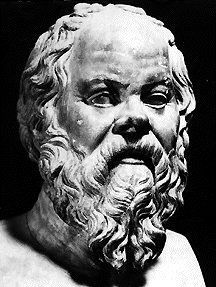
The trial and execution of Socrates in Athens in 399 B.C.E. puzzles historians. Why, in a order enjoying more freedom and republic than any the world had ever seen, would a lxx-year-one-time philosopher be put to death for what he was teaching? The puzzle is all the greater because Socrates had taught--without molestation--all of his adult life. What could Socrates have said or done that prompted a jury of 500 Athenians to send him to his death just a few years earlier he would accept died naturally?
Finding an answer to the mystery of the trial of Socrates is complicated past the fact that the 2 surviving accounts of the defense (or amends) of Socrates both come up from disciples of his, Plato and Xenophon. Historians suspect that Plato and Xenophon, intent on showing their master in a favorable low-cal, failed to nowadays in their accounts the nearly damning testify confronting Socrates.
What appears almost sure is that the decisions to prosecute and ultimately convict Socrates had a lot to practice with the turbulent history of Athens in the several years preceding his trial. An examination of that history may not provide final answers, but it does provide important clues.
BACKGROUND
Socrates, the son of a sculptor (or stonecutter) and a midwife, was a young male child when the rise to power of Pericles brought on the dawning of the "Aureate Age of Greece." As a boyfriend, Socrates saw a fundamental power shift, as Pericles--perchance history'southward get-go liberal political leader--acted on his belief that the masses, and non just property-owning aristocrats, deserved freedom. Pericles created the people'due south courts and used the public treasury to promote the arts. He pushed ahead with an unprecedented building program designed not but to demonstrate the glory that was Greece, but also to ensure full employment and provide opportunities for wealth cosmos among the non-propertied class. The rebuilding of the Acropolis and the construction of the Parthenon were the two best known of Pericles' many ambitious building projects.
Growing to adulthood in this bastion of liberalism and democracy, Socrates somehow developed a set of values and beliefs that would put him at odds with near of his beau Athenians. Socrates was non a democrat or an egalitarian. To him, the people should not be self-governing; they were similar a herd of sheep that needed the management of a wise shepherd. He denied that citizens had the basic virtue necessary to nurture a skilful society, instead equating virtue with a knowledge unattainable by ordinary people. Striking at the heart of Athenian republic, he contemptuously criticized the right of every citizen to speak in the Athenian associates.
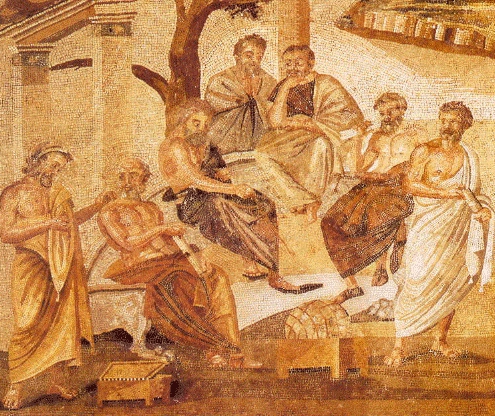
Socrates (rubbing chin) and Plato (under tree) from a mosaic from Pompeii
Writing in the tertiary-century C.E. in his The Lives of Eminent Philosophers, Diogenes Laertius reported that Socrates "discussed moral questions in the workshops and the marketplace." Often his unpopular views, expressed disdainfully and with an air of condescension, provoked his listeners to anger. Laertius wrote that "men set upon him with their fists or tore his hair out," but that Socrates "bore all this sick-usage patiently."
Nosotros become one gimmicky view of Socrates from playwright Aristophanes. In his play Clouds, first produced in 423 B.C.Due east., Aristophanes presents Socrates every bit an eccentric and comic headmaster of a "thinkery" (or "thoughtery"). He is portrayed "stalking the streets" of Athens barefoot, "rolling his eyes" at remarks he found unintelligent, and "gazing up" at the clouds. Socrates at the time of Clouds must accept been perceived more as a harmless boondocks grapheme than as a serious threat to Athenian values and democracy. Socrates himself, plainly, took no offense at his portrayal in Clouds. Plutarch, in his Moralia, quoted Socrates equally maxim, "When they break a jest upon me in the theatre, I experience as if I were at a big party of good friends." Plato, in his Symposium, describes Socrates and Aristophanes engaged in friendly chat.
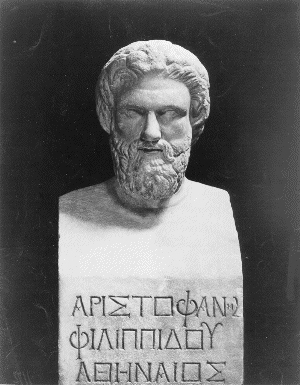 Bust of Aristophanes
Other plays of the time offer boosted clues equally to the reputation of Socrates in Athens. Comic poet Eupolis has one of his characters say: "Yes, and I loathe that poverty-stricken windbag Socrates, who contemplates everything in the world but does not know where his side by side meal is coming from." Birds, a play of Aristophanes written 6 years subsequently his Clouds, contains a revealing reference. Aristophanes labels a gang of pro-Sparta aristocratic youths equally "Socratified." Sparta--the model of a closed guild--and Athens were enemies: the remark suggests Socrates' didactics may take started to exist seen as destructive by 417 B.C.E.
The standing of Socrates amongst his fellow citizens suffered mightily during two periods in which Athenian democracy was temporarily overthrown, one four-month menstruation in 411-410 and another slightly longer period in 404-403. The prime number movers in both of the anti-autonomous movements were former pupils of Socrates, Alcibiades and Critias. Athenians undoubtedly considered the teachings of Socrates--particularly his expressions of disdain for the established constitution--partially responsible for the resulting decease and suffering. Alcibiades, perhaps Socrates' favorite Athenian politico, masterminded the beginning overthrow. (Alcibiades had other strikes confronting him: four years earlier, Alcibiades had fled to Sparta to avert facing trial for mutilating religious pillars--statues of Hermes--and, while in Sparta, had proposed to that state's leaders that he assist them defeat Athens.) Critias, first among an oligarchy known as the "Xxx Tyrants," led the 2d bloody revolt against the restored Athenian democracy in 404. The revolt sent many of Athens's leading democratic citizens (including Anytus, later the driving force behind the prosecution of Socrates) into exile, where they organized a resistance motion.
Critias, without question, was the more frightening of the two onetime pupils of Socrates. I.F. Rock, in his The Trial of Socrates, describes Critias (a cousin of Plato's) as "the first Robespierre," a fell and inhumane homo "determined to remake the city to his own antidemocratic mold whatever the human price." The oligarchy confiscated the estates of Athenian aristocrats, banished five,000 women, children, and slaves, and summarily executed about 1,500 of the most prominent democrats of Athens.
One incident involving Socrates and the Thirty Tyrants would after become an issue at his trial. Although the Thirty normally used their ain gang of thugs for such duties, the oligarchy asked Socrates to abort Leon of Salamis so that he might be executed and his assets appropriated. Socrates refused to practice so. Socrates would point to his resistance to the club equally bear witness of his good conduct. On the other hand, Socrates neither protested the conclusion nor took steps to warn Leon of Salamis of the society for his arrest--he just went abode. While adept citizens of Athens were being liquidated right and left, Socrates--so far every bit we know--did or said nothing to stop the violence.
The horrors brought on past the Thirty Tyrants caused Athenians to wait at Socrates in a new light. His teachings no longer seemed then harmless. He was no longer a lovable boondocks eccentric. Socrates--and his icy logic--came to be seen as a dangerous and corrupting influence, a breeder of tyrants and enemy of the mutual man.
THE TRIAL
A general amnesty issued in 403 meant that Socrates could not be prosecuted for any of his actions during or before the reign of the Thirty Tyrants. He could only exist charged for his actions during the four years preceding his trial in 399 B.C.E. It appears that Socrates, undeterred by the antidemocratic revolts and their aftermaths, resumed his teachings and once once again began attracting a similar ring of youthful followers. The final straw may well take been another antidemocratic uprising--this one unsuccessful--in 401. Athens finally had plenty of "Socratified" youth.
In Athens, criminal proceedings could exist initiated by any citizen. In the case of Socrates, the proceedings began when Meletus, a poet, delivered an oral summons to Socrates in the presence of witnesses. The summons required Socrates to appear before the legal magistrate, or King Archon, in a colonnaded building in primal Athens called the Royal Stoa to answer charges of impiety and corrupting the youth. The Archon determined--after listening to Socrates and Meletus (and perhaps the other two accusers, Anytus and Lycon)--that the lawsuit was permissible under Athenian law, set a date for the "preliminary hearing" (anakrisis), and posted a public discover at the Royal Stoa.
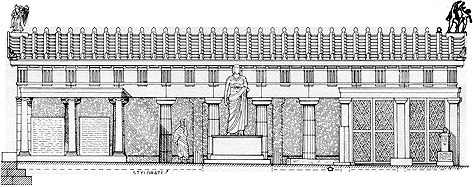 Royal Stoa (scene of the preliminary hearing for Socrates)
The preliminary hearing earlier the magistrate at the Majestic Stoa began with the reading of the written accuse by Meletus. Socrates answered the accuse. The magistrate questioned both Meletus and Socrates, then gave both the accuser and defendant an opportunity to question each other. Having establish merit in the allegation confronting Socrates, the magistrate drew up formal charges. The certificate containing the charges confronting Socrates survived until at least the second century C.E. Diogenes Laertius reports the charges as recorded in the now-lost document:
This indictment and affidavit is sworn by Meletus, the son of Meletus of Pitthos, against Socrates, the son of Sophroniscus of Alopece: Socrates is guilty of refusing to recognize the gods recognized by the state, and of introducing new divinities. He is also guilty of corrupting the youth. The penalty demanded is decease.
The trial of Socrates took place over a nine-to-ten hr catamenia in the People'south Court, located in the agora, the borough center of Athens. The jury consisted of 500 male citizens over the historic period of 30, chosen by lot. Well-nigh of the jurors were probably farmers. The jurors sat on wooden benches separated from the large crowd of spectators--including a 27-twelvemonth-one-time pupil of Socrates named Plato--by some sort of barrier or railing.
Guilt Phase of Trial
The trial began in the morn with the reading of the formal charges against Socrates past a herald. The prosecution presented its case first. The iii accusers, Meletus, Anytus, and Lycon, had a total of three hours, measured by a water clock, to present from an elevated stage their argument for guilt. No record of the prosecution's argument confronting Socrates survives.
Easily the best known and nigh influential of the three accusers, Anytus, is widely believed to take been the driving strength backside the prosecution of Socrates. Plato's Meno offers a possible clues equally to the animosity between Anytus, a politician coming from a family of tanners, and Socrates. In the Meno, Plato reports that Socrates's statement that the bang-up statesmen of Athenian history have nothing to offer in terms of an understanding of virtue enrages Anytus. Plato quotes Anytus as warning Socrates: "Socrates, I think that you lot are also ready to speak evil of men: and, if you will accept my communication, I would recommend y'all to exist careful." Anytus had an additional personal gripe apropos the relationship Socrates had with his son. Plato quotes Socrates equally saying, "I had a brief association with the son of Anytus, and I found him non lacking in spirit." It is not known whether the relationship included sex, but Socrates--equally were many men of the time in Athens--was bisexual and slept with some of his younger students. Anytus almost certainly disapproved of his son'south relationship with Socrates. Adding to the displeasure of Anytus must have been the communication Socrates gave to his son. Co-ordinate to Xenophon, Socrates urged Anytus's son not to "continue in the servile occupation [tanning hides] that his father has provided for him." Without a "worthy adviser," Socrates predicted, he would "autumn into some disgraceful propensity and will surely go far in the career of vice."
It is a matter of dispute among historians whether the accusers focused more attention on the alleged religious crimes, or the alleged political crimes, of Socrates. I. F. Stone attaches far more significance to the political crimes, while other historians such as James A. Colaiaco, author of Socrates Confronting Athens, give more weight to the accuse of impiety.
I. F. Stone argues that "Athenians were accustomed to hearing the gods treated disrespectfully in both the comic and tragic theatre." He points out that Aristophanes, in his Clouds, had a character speculating that rain was Zeus urinating through a sieve, mistaking it for a bedchamber pot--and that no one e'er bothered to charge Aristophanes with impiety. Rock concludes: "One could in the aforementioned metropolis and in the same century worship Zeus as a promiscuous one-time rake, henpecked and cuckolded past Juno or as Justice deified. Information technology was the political, not the philosophical or theological, views of Socrates which finally got him into trouble."
Important support for Rock'due south conclusion comes from the earliest surviving reference to the trial of Socrates that does not come from one of his disciples. In 345 B.C.E., the famous orator Aechines told a jury: "Men of Athens, yous executed Socrates, the sophist, because he was clearly responsible for the education of Critias, one of the thirty anti-democratic leaders."
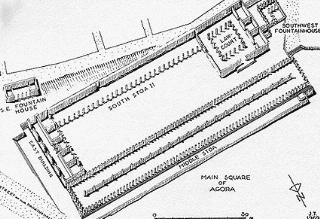 Heliaea (Law Courtroom, scene of the trial of Socrates)
James Colaiaco's determination that impiety received more prosecutorial attention than did political sins rests on Plato's Amends. Colaiaco sees Plato's famous account of the defense of Socrates every bit being--although far from a verbatim transcription of the words of Socrates--fairly representative of the major points of his defense. He notes that Plato wrote the Apology within a few years of the trial and must take expected many of his readers to take immediate knowledge of the trial. Why, Colaiaco asks, would have Plato misrepresented the arguments of Socrates, or hid key elements of the prosecution's case, when his actions in doing so could so easily be exposed? Since the Apology seems to requite bang-up weight to the charge of impiety--and relatively footling weight to the clan of Socrates with the Thirty Tyrants--Colaiaco assumes this must have been a fair reflection of the trial. At the same time, Colaiaco recognizes that considering of the association of Socrates with Critias "the prosecution could expect whatsoever Athenian jury to harbor hostile feelings toward the metropolis'south gadfly."
Piety had, for Athenians, a broad pregnant. Information technology included not simply respect for the gods, but likewise for the dead and ancestors. The impious individual was seen as a contaminant who, if not controlled or punished, might bring upon the metropolis the wrath of the gods--Athena, Zeus, or Apollo--in the course of plague or sterility. The ritualistic religion of Athens included no scripture, church, or priesthood. Rather, it required--in addition to conventionalities in the gods-- observance of rites, prayers, and the offering of sacrifices.
Any number of words and actions of Socrates may have contributed to his impiety charge. Preoccupied with his moral instruction, he probably failed to attend important religious festivals. He may take stirred additional resentment by offering arguments against the collective, ritualistic view of organized religion shared by about Athenians or by contending that gods could not, as Athenians believed, acquit immorally or whimsically. Xenophon indicates that the impiety charge stemmed primarily from the contention of Socrates that he received divine communications (a "voice" or a "sign") directing him to avoid politics and concentrate on his philosophic mission. A vague accuse such as impiety invited jurors to projection their many and varied grievances against Socrates.
Dozens of accounts of the iii-hour spoken communication (apologia) by Socrates in his defence existed at one time. Only Plato'south and Xenophon'south accounts survive. The ii accounts hold on a key bespeak. Socrates gave a defiant--decidedly united nationsatoning--voice communication. He seemed to invite condemnation and death.
Plato'southward apology describes Socrates questioning his accuser, Meletus, about the impiety charge. Meletus accuses Socrates of believing the sun and moon not to exist gods, but merely masses of stone. Socrates responds non past specifically denying the accuse of atheism, merely by attacking Meletus for inconsistency: the charge against him accused him of believing in other gods, not in assertive in no gods. If Plato'southward business relationship is accurate, Socrates could take been seen past jurors offer a smokescreen rather than a refutation of the charge of impiety.
Plato's Socrates provocatively tells his jury that he is a hero. He reminds them of his exemplary service as a hoplite in three battles. More than chiefly, he contends, he has battled for decades to save the souls of Athenians--pointing them in the direction of an examined, ethical life. He reportedly says to his jurors if his pedagogy about the nature of virtue "corrupts the youth, I am a mischievous person." He tells the jury, according to Plato, he would rather be put to death than give up his soul-saving: "Men of Athens, I honor and honey you; just I shall obey God rather than you, and while I have life and forcefulness I shall never end from the practise and teaching of philosophy." If Plato'south business relationship is accurate, the jury knew that the only way to stop Socrates from lecturing almost the moral weaknesses of Athenians was to impale him.
If I. F. Rock is right, the virtually damaging accusation against Socrates concerned his association with Critias, the roughshod leader of the Thirty Tyrants. Socrates, in Plato'southward business relationship, points to his refusal to comply with the Tyrants' lodge that he bring in Leon of Salamis for summary execution. He argues this act of disobedience--which might accept led to his own execution, had not the Tyrants fallen from power--demonstrates his service as a good citizen of Athens. Stone notes, however, that a good citizen might have done more than simply become dwelling to bed--he might have warned Leon of Salamis. In Stone'southward critical view, the cardinal fact remained that in the city's darkest hour, Socrates "never shed a tear for Athens." Every bit for the accuse that his moral instruction provided intellectual comprehend for the anti-democratic revolt of Critias and his cohorts, Socrates denies responsibility. He argues that he never presumed to exist a instructor, just a figure who roamed Athens answering the questions that were put to him. He points to his pupils in the crowd and observes that none of them accused him. Moreover, Socrates suggests to the jury, if Critias really understood his words, he never would take gone on the bloody rampage that he did in 404-403. Hannah Arendt notes that Critias apparently concluded, from the bulletin of Socrates that piety cannot be defined, that it is permissible to be impious--"pretty much the contrary of what Socrates had hoped to attain by talking about piety."
What is strikingly absent-minded from the defense of Socrates, if Plato'south and Xenophon's accounts are to be believed, is the plea for mercy typically fabricated to Athenian juries. It was common practice to entreatment to the sympathies of jurors past introducing wives and children. Socrates, however, did no more than than remind the jury that he had a family unit. Neither his wife Xanthippe nor whatever of his three sons made a personal appearance. On the contrary, Socrates--co-ordinate to Plato--contends that the unmanly and pathetic exercise of pleading for clemency disgraces the justice system of Athens.
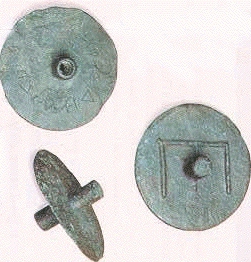
Fourth-century BCE ballot disks
When the iii-60 minutes defense of Socrates came to an terminate, the court herald asked the jurors to return their decision past putting their ballot disks in i of two marked urns, i for guilty votes and one for votes for amortization. With no judge to offer them instructions as to how to interpret the charges or the police force, each juror struggled for himself to come to an understanding of the instance and the guilt or innocence of Socrates. When the ballots were counted, 280 jurors had voted to discover Socrates guilty, 220 jurors for acquittal.
Penalty Stage of Trial
After the conviction of Socrates by a relatively close vote, the trial entered its penalty stage. Each side, the accusers and the defendant, was given an opportunity to propose a punishment. After listening to arguments, the jurors would choose which of the 2 proposed punishments to adopt.
The accusers of Socrates proposed the punishment of death. In proposing death, the accusers might well have expected to counter with a proposal for exile--a penalisation that probably would take satisfied both them and the jury. Instead, Socrates audaciously proposes to the jury that he be rewarded, not punished. According to Plato, Socrates asks the jury for gratis meals in the Prytaneum, a public dining hall in the center of Athens. Socrates must have known that his proposed "penalisation" would infuriate the jury. I. F. Stone noted that "Socrates acts more like a picador trying to enrage a bull than a accused trying to mollify a jury." Why, then, propose a penalty guaranteed to be rejected? The only answer, Stone and others conclude, is that Socrates was ready to die.
To comply with the demand that a genuine penalty be proposed, Socrates reluctantly suggested a fine of ane mina of argent--about one-fifth of his pocket-sized net worth, according to Xenophon. Plato and other supporters of Socrates upped the offer to 30 minae past agreeing to come up with silver of their own. Most jurors likely believed even the heftier fine to be far too slight of a punishment for the unrepentant defendant.
In the final vote, a larger majority of jurors favored a punishment of death than voted in the commencement instance for confidence. According to Diogenes Laertius, 360 jurors voted for death, 140 for the fine. Under Athenian law, execution was accomplished past drinking a cup of poisoned hemlock.
In Plato'southward Apology, the trial concludes with Socrates offer a few memorable words as court officials finished their necessary work. He tells the oversupply that his conviction resulted from his unwillingness to "address you equally you would accept liked me to do." He predicts that history will come to see his conviction every bit "shameful for Athens," though he professes to have no ill will for the jurors who convict him. Finally, as he is being led off to jail, Socrates utters the memorable line: "The hr of divergence has arrived, and nosotros become our ways--I to die, and you to live. Which to the better fate is known just to God." It is likely that this last outburst of eloquence comes from Plato, not Socrates. There are no records suggesting that Athenian practice allowed defendants to speak after sentencing.
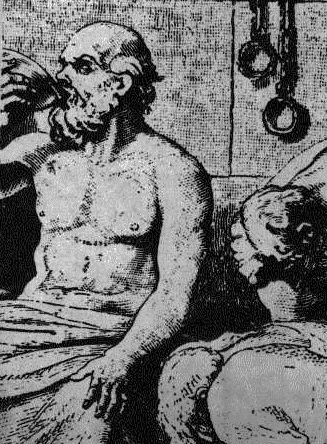
Socrates drinking a loving cup of hemlock
Socrates spent his final hours in a prison cell in the Athens jail. The ruins of the jail remain today. The hemlock that concluded his life did not exercise then quickly or painlessly, but rather past producing a gradual paralysis of the central nervous system.
Almost scholars meet the conviction and execution of Socrates equally a deliberate selection made past the famous philosopher himself. If the accounts of Plato and Xenophon are reasonably accurate, Socrates sought not to persuade jurors, only rather to lecture and provoke them.
The trial of Socrates thus became the well-nigh interesting suicide the world has ever seen. Had he wanted to, Socrates could have won an acquittal. The closeness of the vote shows that there was nil inevitable about his sentence. If he had been less condescending, less confrontational, less big-headed; if he had argued he was just exercising his bones right of free speech, a right of which Athenians were justly proud, jurors might have been more than receptive. Merely Socrates couldn't bring himself to rely on a principle he so frequently had criticized. He was uncompromising. He showed no hint of respect for Athens or her institutions in his defense. For Socrates, being a good person came first; beingness a practiced citizen was a poor second. As a matter of personal integrity, he made Athenians cull between their love of freedom and their dear of community—and, in the end, they chose community.
Socrates knew how to die. The manner in which he chose to dice enhanced his reputation among his associates and made him the offset nifty martyr for the cause of complimentary speech, a sort of secular saint.
As I. F. Stone observed, just equally Jesus needed the cantankerous to fulfill his mission, Socrates needed his hemlock to fulfill his.
Source: https://www.famous-trials.com/socrates/833-home

Post a Comment for "what was socratess mission to the city of athens"